
 By
By 
Defining the Modern Digital Marketing Strategy
The digital marketing landscape is changing at an unprecedented speed. Many marketers feel their industry has transformed more in the last two years than in the previous fifty combined. This pace is only accelerating, especially as we look at 2026. Businesses today face new challenges and opportunities. Relying on old methods simply won’t work anymore.
In this dynamic environment, a robust Digital Marketing Strategy is not just an advantage; it’s essential for survival and growth. It’s about more than just running ads or posting on social media. It’s about building a clear, long-term plan to connect with your audience, drive revenue, and build a lasting brand. The rise of AI, new privacy regulations, and evolving search behaviors mean that adapting your approach is non-negotiable. To truly dominate the digital space, we must leverage cutting-edge tools and insights.
This guide will explore the foundations of modern Digital Marketing Strategies. We will define what a strategy truly is, distinguish it from mere campaigns and tactics, and explain why it’s more crucial than ever. We’ll delve into the key components, highlight effective channels, and show how emerging technologies like AI and video are reshaping the field. For those looking to integrate advanced solutions, understanding the power of LooneyContent AI digital marketing becomes increasingly vital. You’ll also learn a step-by-step approach to building your own strategy and how to measure its success in this AI-driven era.
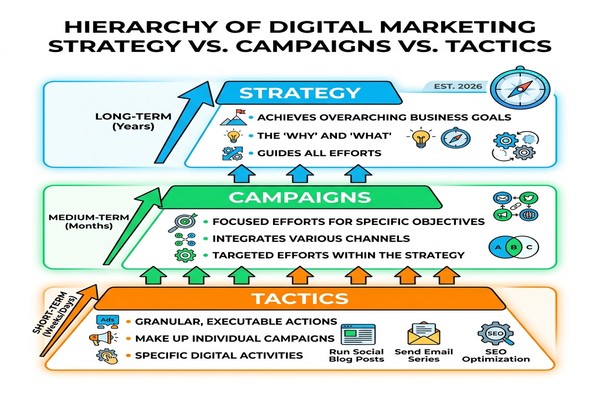
In April 2026, a digital marketing strategy is far more than a checklist of online activities. It’s a comprehensive, long-term blueprint that outlines how a business will achieve its overarching marketing objectives through digital channels. This strategic vision encompasses everything from identifying target audiences and setting measurable goals to allocating resources and selecting the most impactful digital tactics. It’s the “why” and the “what” before the “how.”
At its core, a robust strategy provides a framework for all digital efforts, ensuring they are aligned and working synergistically towards a common business outcome. This is crucial for building what we call a “brand fortress”-a resilient and dominant online presence that can withstand market shifts and competitive pressures. A key aspect of this in 2026 is Generative Engine Optimization (GEO). With AI Overviews increasingly dominating search results, optimizing for machine readability and quotable passages is no longer optional; it’s fundamental. Our content must be structured not just for human readers but also for AI models that scrape and synthesize information. This means clear, concise answers, structured data, and authoritative sources are paramount.
The distinction between strategy, campaigns, and tactics is vital for effective execution. A strategy is your long-term plan to achieve a major business goal (e.g., “Become the market leader in sustainable fashion”). A campaign is a medium-term, focused effort designed to achieve a specific objective within that strategy (e.g., “Launch a new eco-friendly line to increase market share by 15%”). Tactics are the short-term, granular actions that make up a campaign (e.g., “Run Instagram ads targeting eco-conscious consumers,” “Publish blog posts on sustainable materials,” “Send a series of welcome emails to new subscribers”). Without a clear strategy, campaigns and tactics can become disconnected, leading to wasted resources and underperforming results.
Core Components of Successful Digital Marketing Strategies
Building an effective digital marketing strategy in April 2026 requires a meticulous approach, focusing on several key components that act as its foundation.
First, SMART goals are non-negotiable: Specific, Measurable, Achievable, Relevant, and Time-bound. Instead of a vague goal like “increase sales,” a SMART goal might be “increase online sales by 20% in the next 12 months through targeted email marketing and SEO improvements.” These clear objectives provide direction and a benchmark for success.
Second, understanding your buyer personas is paramount. Who are you trying to reach? What are their demographics, psychographics, pain points, and online behaviors? Developing detailed personas allows us to tailor messaging, content, and channel selection, ensuring our efforts resonate with the right audience.
Third, first-party data has become a competitive moat. With the functional demise of third-party cookies, collecting and leveraging data directly from our audience (e.g., website interactions, email sign-ups, purchase history) is crucial for personalization and effective targeting. This data helps us understand customer journeys and build stronger relationships.
Fourth, cultivating brand authority and well-being is more important than ever. In a crowded digital space, trust and credibility differentiate businesses. This involves consistent branding, valuable content, and positive customer experiences. We’ve often discussed the importance of brand well-being and its competitive advantages, emphasizing that a strong, reputable brand naturally attracts and retains customers.
The nuances between B2B vs. B2C businesses also significantly impact strategy. B2B strategies often involve longer sales cycles, multiple decision-makers, and a focus on lead generation and thought leadership (e.g., whitepapers, webinars). B2C, conversely, often prioritizes brand awareness, emotional connection, and direct sales through channels like social media and e-commerce. For specialized sectors like home services, digital marketing strategies need to be incredibly targeted, often leveraging local SEO and reputation management, as highlighted by experts in digital marketing strategies for home services.
Finally, budget allocation is a critical component. A strategic budget isn’t just about how much to spend, but where to spend it for maximum impact. This involves analyzing the ROI of different channels and continuously optimizing spend. As we’ve seen in insights from Forbes, maximizing advertising dollars requires a strategic approach to allocation and performance monitoring.
Implementing Digital Marketing Strategies on a Budget
For small businesses, implementing effective digital marketing strategies on a limited budget is a common challenge, but it’s far from impossible. The key is to be strategic, prioritize high-impact activities, and leverage cost-effective channels.
Local SEO is a powerhouse for small businesses. Optimizing your Google Business Profile, accumulating positive reviews, and ensuring your website is optimized for local keywords (e.g., “salons in New Haven, CT”) can drive significant foot traffic and online inquiries. This ensures you appear prominently when potential customers search for services in their immediate vicinity.
Community engagement through social media, local partnerships, and online groups can build brand loyalty and generate word-of-mouth referrals without hefty ad spend. Actively responding to comments, sharing local news, and supporting other small businesses fosters a strong community presence.
User-generated content (UGC) is incredibly powerful and low-cost. Encourage customers to share their experiences with your product or service online. This authentic content acts as social proof and can be repurposed across your channels. Running simple contests or asking for testimonials can spur UGC creation.
Email marketing remains one of the most cost-effective channels. With an average ROI of $36 for every $1 invested, it’s a direct line to your customers. Building an email list through website sign-ups, pop-ups, and in-store promotions allows for direct communication about offers, updates, and valuable content. More than 80% of companies use email marketing, and over 50% of consumers make a purchase from a marketing email at least once a month.
Investing in core services that provide foundational digital marketing support, such as website optimization and content creation, can yield long-term benefits. Showcasing your previous work through case studies and testimonials can also serve as a powerful, low-cost marketing tool.
Micro-influencers, who have smaller but highly engaged audiences, can also be a more affordable and effective option for small businesses compared to macro-influencers. Their authenticity often leads to higher engagement rates and better ROI.
High-Impact Channels: From Search to Social
In the diverse ecosystem of digital marketing, several channels consistently deliver high impact when integrated into a cohesive strategy.
Search Engine Optimization (SEO) is foundational. Almost every user begins their product or service search with a search engine. SEO ensures your business ranks high in organic search results, driving qualified traffic. This includes technical SEO (site speed, mobile-friendliness), on-page SEO (keyword optimization, content quality), and off-page SEO (backlinks, local SEO). SEO is not just about visibility; it’s about intercepting users at every stage of the buying funnel.
Pay-Per-Click (PPC) advertising offers immediate visibility and precise targeting. Platforms like Google Ads allow businesses to bid on keywords, displaying ads to users actively searching for their products or services. PPC is highly measurable, making it easy to track ROI and optimize campaigns. It’s particularly effective for quick boosts or when organic rankings are still developing.
Content Marketing builds authority, engages audiences, and supports SEO. This involves creating and distributing valuable, relevant, and consistent content (blog posts, articles, videos, infographics) to attract and retain a clearly defined audience. For example, a ski and snowboard business might create instructional blog posts on beginner gear or maintenance.
Email Marketing continues to be a powerhouse. As mentioned, it boasts an impressive average ROI of $36 for every $1 invested, making it a cornerstone of retention and direct sales efforts. Automated email flows, such as welcome series, abandoned cart reminders, and personalized recommendations, significantly boost engagement and conversions.
Social Media Marketing is about building community, driving brand awareness, and engaging directly with customers. While less than 30% of companies use social media as a strategic marketing channel, nearly 3.5 billion people use social media, presenting a massive opportunity. Platforms like Instagram and TikTok are crucial for visual storytelling and reaching younger demographics, often through engaging Social Media Videos. A comprehensive social strategy goes beyond casual posting, requiring integrated, data-driven approaches.
Affiliate Marketing leverages external partners to promote products or services in exchange for a commission. This performance-based model was estimated to be a $13 billion industry in 2023, demonstrating its significant reach and effectiveness. It allows businesses to tap into new audiences through trusted voices. For businesses seeking to implement truly elite digital marketing strategies, a multi-channel approach that integrates these high-impact areas is essential. This integrated approach ensures that every touchpoint with a potential customer is optimized and contributes to the overall strategic goals.
The Role of AI and Video in Digital Marketing Strategies
In April 2026, Artificial Intelligence (AI) is not just a buzzword; it’s a transformative force reshaping every aspect of digital marketing. AI is revolutionizing how we understand our audience, personalize experiences, optimize campaigns, and even create content.

Generative AI tools are now widely used for drafting content, generating ad copy, and even creating images and videos, significantly improving efficiency. However, the human touch remains critical for ensuring authenticity, accuracy, and brand voice. AI also plays a crucial role in data analysis, identifying patterns and predicting trends that inform strategic decisions. Our Ai Tools are designed to harness this power, optimizing media and ensuring maximum impact.
Voice search has become a dominant trend, with users increasingly relying on voice assistants for information and purchases. This shift necessitates optimizing content for featured snippets-the concise answers that voice assistants pull directly from search results. For example, a query like “How do I clean a stinky dishwasher?” will likely yield a featured snippet as a voice response. This means content must be structured to provide clear, direct answers to common questions.
Video integration is no longer optional; it’s a cornerstone of engagement. Ninety-one percent of marketers are expected to use video in 2026. From short-form content on TikTok and Instagram Reels to longer educational videos on YouTube, video captures attention and conveys complex messages effectively. When combined with SEO, video content can significantly boost visibility and engagement.
The rise of conversational search and zero-click trends (where users find answers directly in search results without clicking through to a website) means that our content must be discoverable and digestible by AI. This reinforces the need for GEO and machine readability.
Building Your Strategy Step-by-Step
Crafting a robust digital marketing strategy in April 2026 involves a systematic process, moving from foundational analysis to continuous optimization.
- Set SMART Goals: Begin by defining clear, measurable, achievable, relevant, and time-bound objectives. These should align directly with your overall business goals.
- Develop Buyer Personas: Create detailed profiles of your ideal customers, including demographics, behaviors, motivations, and pain points.
- Audit Existing Assets: Conduct a comprehensive review of your current digital presence-website, social media, content, SEO performance, and analytics. Identify strengths, weaknesses, and opportunities.
- Conduct a Competitor SWOT Analysis: Analyze your competitors’ Strengths, Weaknesses, Opportunities, and Threats in the digital space. This helps identify gaps and areas for differentiation.
- Establish Budget: Allocate resources strategically across different channels based on expected ROI and business priorities.
- Choose Strategies & Channels: Select the most effective digital marketing strategies (e.g., SEO, PPC, email, social) and specific channels based on your goals, audience, and budget.
- Plan Content & Execution (90-Day Roadmap): Develop a content calendar and an actionable 90-day roadmap. This includes specific campaigns, content creation, and launch schedules. Consider implementing a pillar-cluster model for content, where a central “pillar” article links to several related “cluster” articles, boosting SEO and authority. Our Case Studies often highlight the impact of structured content planning.
- Implement Automation Flows: Set up essential email automation flows (welcome series, nurture sequences, re-engagement campaigns) and leverage AI for personalization.
- Integrate CRM: Connect your marketing efforts with your Customer Relationship Management (CRM) system to track leads, customer interactions, and sales conversions seamlessly.

Measuring Success in an AI-Driven Landscape
Measuring the success of digital marketing strategies in April 2026 requires moving beyond traditional metrics to embrace a more holistic, revenue-focused approach. The proliferation of AI and the shift towards conversational search means we need to adapt our Key Performance Indicators (KPIs).
Traditional KPIs AI-Era Metrics (2026) Website Traffic Share of Visibility (in AI Overviews/Featured Snippets) Click-Through Rate (CTR) Engagement Rate (on AI-generated answers, video views) Conversion Rate Revenue Optimization (across multi-touch attribution) Cost Per Click (CPC) Customer Lifetime Value (CLV) & Cost Per Acquisition (CPA) Social Media Followers Brand Citations & Sentiment Analysis (AI-driven) Bounce Rate Time on Page (for valuable content) & Scroll Depth Attribution modeling has become more complex and critical. Moving away from last-click attribution, we now emphasize data-driven attribution (DDA) models that assign credit to multiple touchpoints along the customer journey. Integrating CRM data is essential for understanding the full lead-to-revenue path.
Share of visibility in AI-generated answers and featured snippets is a new, crucial metric. As AI Overviews increasingly provide direct answers, appearing in these prominent positions becomes a key indicator of search dominance.
The focus has shifted towards revenue optimization. Every marketing activity should be tied back to its contribution to the bottom line. This involves continuous testing, learning, and data-driven refinement of strategies. Our Media Differentiators emphasize this data-centric approach, ensuring that every dollar spent contributes to measurable growth.
Top KPIs for Digital Marketing Strategies
Beyond the evolving landscape, some core KPIs remain essential for evaluating the health and effectiveness of your digital marketing efforts:
- Customer Lifetime Value (CLV): The total revenue a business can expect from a single customer account. This long-term metric helps justify acquisition costs and informs retention strategies.
- Cost Per Acquisition (CPA): The total cost associated with acquiring one new customer through a specific marketing campaign or channel.
- Brand Citations: Mentions of your brand online, even without a direct link, indicating brand awareness and authority, especially valuable in the AI era.
- Engagement Rate: Measures how actively your audience interacts with your content on social media, email, or your website (likes, shares, comments, clicks, time on page).
- Return on Investment (ROI): The ultimate measure of profitability, calculating the financial gain or loss relative to the cost of an investment. Benchmarks, such as email marketing’s $36 ROI for every $1 invested, highlight the potential of well-executed strategies.
🚀 Want to See These Tactics in Action? At Looney Content, we blend AI technology with creative storytelling to build brand fortresses that withstand the shifts of 2026. Learn how our AI-powered media optimization works →
Frequently Asked Questions about Digital Marketing Strategies
What is the difference between a marketing strategy and a marketing tactic?
A strategy is a long-term, high-level plan designed to achieve specific business goals, defining objectives, target audiences, and the overall framework for digital channels. Tactics are the individual, short-term actions or specific methods (e.g., running a specific ad campaign, optimizing a blog post for a keyword) used to execute that broader strategy. The strategy is the “what” and “why,” while tactics are the “how.”
How has AI changed digital marketing strategies in 2026?
AI has dramatically shifted the landscape in 2026 by enabling Generative Engine Optimization (GEO), which focuses on structuring content for AI models and conversational search. It facilitates hyper-personalization in email and advertising, automates routine tasks, and provides advanced data analytics for real-time optimization. AI also influences search results through AI Overviews, making “share of visibility” a crucial new metric.
Why is email marketing still considered highly effective?
Email marketing remains highly effective due to its direct communication channel, high personalization capabilities, and exceptional ROI. With an average return on investment (ROI) of $36 for every $1 invested, and over 50% of consumers reporting they make a purchase from a marketing email at least once a month, it continues to be a powerful tool for customer retention, nurturing leads, and driving direct sales. It allows businesses to own their audience data, reducing reliance on third-party platforms.
Conclusion
The digital marketing landscape in April 2026 is dynamic, complex, and filled with unprecedented opportunities. By understanding the core components of a robust digital marketing strategy, differentiating it from mere campaigns and tactics, and embracing the transformative power of AI and emerging channels, businesses can not only survive but thrive. Focusing on building a strong brand fortress, leveraging first-party data, and optimizing for machine readability through Generative Engine Optimization (GEO) are no longer optional-they are critical for modern brand dominance.
Ready to stop guessing and start growing in the 2026 landscape? By focusing on brand authority and machine-readable content, you can dominate the digital space. Explore our AI-powered tools and see what’s possible → https://www.looneycontent.com/ai-tools










Comments